0:00
What's up everybody and welcome to Technicians Tuesday
0:05
This week we'll be talking about summerization and storing your boat for the summer
0:09
which can get a little confusing depending on where you live because in the south
0:13
summerization means to store your boat for the summer, and in the north it means to de-winterize your boat and get it ready for the summer
0:20
So it's a little backwards depending on where you are located, which is why we just wrote an article about the differences between the two
0:26
so if you would like more of a breakdown on the differences, I'll stick a link to it in the description
0:31
Before getting started, we'll only need a couple of things. We'll need some foggy oil and some fuel stabilizer, and that's basically it
0:39
Now, the most effective way of making the stabilizer work, we want to put it in the fuel on our last fill-up
0:45
Then run the boat a couple more times before performing your flesh and fog. This way it gets the stabilizer mixed in really well with the fuel
0:52
and runs through all the fuel system of the engine. It's also important that you use rec 90 fuel and not gas that contains
0:59
any ethanol at all. You don't want to store ethanol fuel in your boat for extended periods
1:03
of time unless you want some serious problems to deal with next season. Since we will be storing
1:08
the boat it important to check the gear loop that in the lower unit to make sure that there isn any water in the lube If you store your boat in the lowers full of water it will rust up the bearings and gears making them prone to failure the more you use the engine
1:23
If you do find that there is water, you can either pull the lower unit and pressure test the gear case
1:29
to find out which seals you need to replace, or you can simply fill up the gear case with some new lube
1:34
and deal with the issue next season. The main thing is that the lower unit isn't stored
1:38
full of water or empty without any loop at all. Both will cause problems down the line
1:44
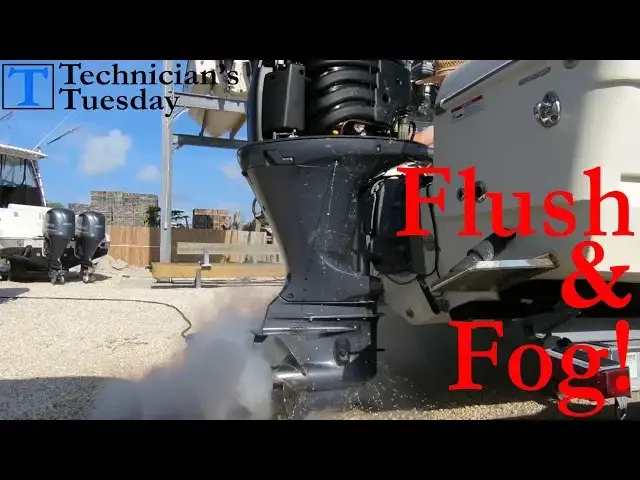
Now it's time to get to the actual flushing and fogging of the engine, which is a pretty simple
1:49
process. We just need to get access to the air intake of the engine. So depending on what brand
1:55
and whether it is a two-stroke or a four-stroke, it will vary from simply removing a hose or a
2:00
sensor to pulling the intake air box off. Then we want to start and run the engine so that we can spray the fogging oil into the air intake
2:15
Now the engine will have a tendency to die during this process so we want to rev up the
2:20
RPMs of the motor to about 1,000 or 1,200 or so just to keep it running
2:25
Sometimes it may require a little more so just rev up the engine until it doesn die as you are spraying the fogging oil in Since we are raising the RPMs it best to have the engine on a set of earmuffs opposed to using the flush fitting that is on the engine
2:40
This way it keeps the water pump impeller wet and cool. We'll start the engine and begin spraying the fogging oil
2:46
into the air intake and continue spraying until we see a nice cloud of smoke coming out of the exhaust
2:57
Letting us know that the engine is good and fogged. because this is more of a southern thing and we don't have to worry about freezing conditions
3:04
we don't need to worry about water plugs and running in a freeze through the engine or anything
3:09
like that. Once the engine is fogged and smoking, quickly turn off the engine key switch and we can
3:20
then put the engine sensors or airbox back on. The last thing we need to do before closing up the engine is to drain out the VST or the
3:28
carburetors and get all of the fuel. out. This is pretty simple. Most VSTs have a drain screw on the bottom as well as a little hose
3:38
that will allow us to drain the fuel into a container. We don't want to let that fuel sit there
3:43
and gum up, causing us some problems when we start the engine next season
3:47
And this is the last thing that we need to do to summarize the engine
4:06
It's important not to forget to take care of the things on the boat, like the cushions and protecting them from the sun
4:12
making sure that the battery switches are turned off and that there isn't any parasitic draw
4:17
that will drain the batteries over the months that you are storing the boat. We'll want to cover up the gauges so they don't get sunburned and develop sunspots
4:25
Then we are ready to put the boat away for the season and close out another day here on this week's Technicians Tuesday
4:32
I know everybody has their own process that they like to do before storing their boat
4:36
so let us know in the comments section below what you do when you put your boat away for the season
4:41
If this is your first video, don't forget to like and subscribe to the channel, then get the bell on so you don't miss out on all the helpful boating hints, tips, and outboard service tricks with us here at born againboating.com every Tuesday afternoon
4:56
Next week we'll be changing out a set of control cables. Now enjoy your Tuesday night and we'll see you next week