live_tv
Livestream Starting Soon
00
Hours
:
00
Minutes
:
00
Seconds
Up next in 10


Learn More About Your Boats Systems By Joining The Born Again Boating Academy! https://www.bornagainboating.com/
Get Your Born Again Boating Clothing! https://www.bornagainboatingshop.com
Get Savings On Boat Parts With BAB Coupons At Partsvu Here:
https://shareasale.com/r.cfm?b=1991037&u=3159438&m=119617&urllink=&afftrack=
Please Buy Anything From This Link To Amazon & Help Us Keep Bringing You Content!!!! https://www.amazon.com/?&_encoding=UTF8&tag=bornagainboat-20&linkCode=ur2&linkId=97bb1968e1ac47dfc3703d401d95fb5a&camp=1789&creative=9325
Join this channel to get access to perks:
https://www.youtube.com/channel/UCWZhbfXDCg7_PvlwvierP1A/join
Join this channel to get access to perks:
https://www.youtube.com/channel/UCWZhbfXDCg7_PvlwvierP1A/join
Subscribe To Our Podcast! The Boater's Podcast: https://www.youtube.com/channel/UC6Y2xnr23ERD2n_t51Jv4-Q?sub_confirmation=1
-------------------------------------------------------------------------------------------------------------------------------------------------------------
PARTS USED:
-------------------------------------------------------------------------------------------------------------------------------------------------------------
DONATE
Show More Show Less View Video Transcript
0:00
Every boat is going to have either a permanent fuel tank or an auxiliary fuel tank
0:04
The auxiliary fuel tank is just a fuel tank that you can take out of the boat
0:08
But each one of these fuel tanks are going to have four crucial components to the tank
0:12
The first is going to be the fill port where you fill the fuel up. The second is going to be the vent to the tank, which is going to allow air to be pushed out of the tank when you put fuel into the tank
0:23
and then the next two are going to be the fuel pickup, which is what feeds fuel to your engine
0:30
and then the fuel sending unit, which allows you to see how much fuel you have in the tank
0:35
As far as the fill port and the vent port go, they're very simple. The fill port is where you fill the fuel tank up, and then the vent port is just a vent
0:44
that goes outside of the boat. So that way when you put fuel in the fuel tank, the fuel pushes the air out the vent, and that's basically it
0:51
So if you have a problem with your fuel tank not taking fuel correctly or it just takes you a long time to fill up your fuel tank, you usually are going to have a problem with your vent system, meaning that whenever you put fuel into the tank, there's no way for the air to get out of the tank. So you fill a little bit of fuel up and no air gets out of the tank. So therefore, it backs up and doesn't allow you to continue fueling the tank until you allow some of the air in the tank to get out of the tank
1:21
So troubleshooting the vent side is going to be what you want to look at
1:25
So when it comes to the fuel sender, the fuel senders basically run on resistance
1:30
And it's this resistance reading that is going to tell the gauge or whatever you're using
1:36
There's different types, a whole bunch of different types. We've got another video about how to troubleshoot this system
1:41
So I'll just link that one. But the basic premises is that resistance goes with the sender
1:48
So as the fuel fills up and the sender gets to the top, there's the least amount of resistance
1:55
We've only got 30 oms of resistance on the cinder. And then as the fuel tank gets lower, the resistance is going to go up
2:04
So once the fuel gets all the way down to the bottom and the fuel tank is empty, we've got about 240 oms of resistance
2:12
And that is what is going to tell the gauge to tell you that you are out of fuel
2:18
And then on most of the auxiliary tanks or portable tanks it just going to be a little lever with a float on the end of it And as you fill the tank up it moves up and it have like a little dial on it and it just basically goes to full or goes to empty
2:31
I mean, you don't really need a fuel gauge on a portable tank. You can just pick the tank up and be like, oh, I'm out of fuel
2:36
And then when it comes to the pickups, most of them are all the same. It's just a tube that goes down into the tank
2:41
Most of them have a screen on the bottom of the tube. The tubes will be cut to the depth of the tank, so however big the tank is
2:49
This tube will be cut. Then you can either have ones that like screw down on like a portable tank
2:55
This one is a simple thread in. So this one screws down into a fitting on the tank
3:01
There's also another one that's got an O ring on it. And that one just pushes down and has like a tab that clips it down in
3:07
There's that kind. And then they will go to a fitting like this
3:11
This fitting will just screw into the pickup like that. And you're either going to have a 5.16th inch, a 3.8
3:19
or a half inch, and that is the inside diameter of the fuel hose, which is going to vary based
3:25
on the engine that you have and how much volume of fuel you need to feed to that engine
3:30
And then there is also going to be fittings like this on some tanks, which is an anti-cypine
3:35
valve, which is basically just this fitting with a ball in it
3:39
Some of them have springs. There are different kinds. You've got fuel demand valves, on-demand valves
3:45
Like there's different types of anti-cypening systems. Now basically what this is is a way for this ball to stop fuel from siphoning out of your tank if the fuel line leaves this fitting and goes below the fuel tank
4:02
So if there's a cut in that hose, it will not create a gravity feed which will siphon fuel out of the fuel tank into the bill
4:09
And the siphoning is just one instance. Most outboard boats, they don't really need something like this because the fuel lines do not go below the tank so they cannot grab synchronous
4:19
gravity feed. These are known problems in a lot of boats. But if you've got an inboard boat
4:23
this is something that you definitely need to have in the system. But there are also different
4:27
types of pressure relief systems. Usually they have a carbon canister or some sort of
4:34
filtration system on the vent side of the fuel tank. So that way in the summer, when the
4:39
fuel heats up, it creates pressure in the tank. We've all seen a fuel tank that doesn't
4:44
have the vent close and it bulges out A lot of plastic tanks do that But nowadays a lot of the permanent tanks and a lot of boats will have some sort of pressure relief system built into it usually a carbon canister filter
4:57
or something like that. So that way, if there is more than one PSI of pressure built up in the
5:03
tank, it will release it out of the vent, which will stop the fuel, like if it pressurizes it
5:09
from pushing fuel through the fuel line. There was a lot of problems with like Garados, the
5:14
in line four stuff like that where fuel would heat up it would create pressure
5:18
that pressure would push the fuel through the line into the engine and pressurize
5:23
the fuel that's in the fuel system and the engine which would then get up into a
5:27
vent it would cause all kinds of problems and so pressure is just something that needs to be thought about that's what these things are anti-cyphon valves fuel
5:34
demand valves whatever a different kind you have that is something that could be a
5:38
potential problem but then once the pickup again being either a five-s sixteenth
5:42
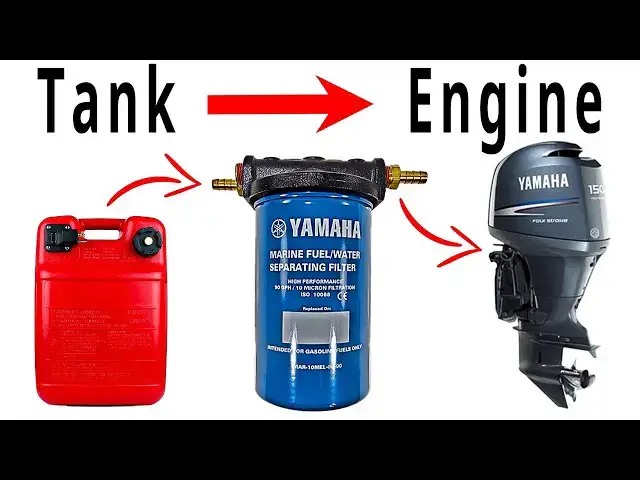
three-eighths or half-inch fuel line it's going to leave here and go to either a fuel selector valve or a fuel water separator
5:50
The fuel selector valve is just there so that way if you have two fuel tanks in the boat
5:54
and say one engine, you can select which fuel tank the engine can pull fuel from
5:59
So if you've got a forward and an aft fuel tank, you can run say 100 gallons in the
6:05
forward and 150 gallons in the aft, that selector valve is going to allow you to select which
6:11
fuel tank you want the engine to pull the fuel from. Then once it goes through that fuel selector valve, it's going to get to the fuel water separator
6:20
The fuel water separator is just a canister like this, and all that does is filters water
6:26
out of the fuel. It's going to come into the bracket on the top like that, go through the filter, and then
6:32
it's going to leave the other side of the bracket and go to your engine
6:37
We have a whole video taking one of these apart, showing how the water sinks to the bottom
6:41
the fuel goes on the top. You can check that out to learn more about those. once the fuel comes out the water separator before it gets to the engine, a lot of models will have a primer bulb
6:50
Some engines do not have primer bulbs. A lot of mercurys don't have primer bulbs in the systems
6:55
Most Yamaha Suzuki's, they will. Now, primer bulbs, super simple. You basically just want to hold them vertical to make them work
7:02
If you ever need to get prime or lose prime, you need to hold it vertically, squeeze it, and then put your finger on the top of it
7:10
and then squeeze it and push it and use your finger to create a suction If you have a problem with your fuel pickup the water separator anything like that if you have a restriction in the fuel line
7:24
where your engine is running, but then all of a sudden it runs out of fuel
7:28
that could mean that you have a restriction on the other side
7:33
One good tell that it will tell you if it's either the engine or the boat
7:37
is if the prime bulb goes flat. So if you squeeze it like this and there's a restriction on the bottom
7:42
it gets sucked flat like that. So if the fuel pump that is on the engine is trying to pull fuel
7:49
and it can't because there's a restriction on the pickup, on this side of the primer bulb, it will suck it completely flat
7:57
and then you know you won't get any fuel, you'll run out of fuel. So basically the fuel pump that is on the engine
8:03
is going to be trying to pull fuel from the tank. If you have a problem from the tank to the engine
8:09
then most of the time the fuel pump does not have enough vacuum to be able to pull the fuel from the tank because the restriction, whether
8:17
that be on the pickup, on the anti-cyphing valve, or the fitting that is right there on the fuel
8:23
line, would that be a clogged or dirty water separator, whether that be a problem with your
8:28
primer bulb? One of those things could be a restriction not allowing the fuel pump that's on
8:33
the engine to be able to pull the fuel from the fuel tank and feed fuel to the engine
8:38
And one other thing that we've done another video about in order to test a system like
8:42
this is you can put a clear fuel hose on this side of the primer bulb, which is going to
8:48
the engine, because this should be the last connection point of your fuel line going to the engine
8:54
If you put a clear hose right here and you see air bubbles, that means that Copenholb, water
8:59
separator, anti-siphon valve, the pickup, something in that system, the fuel lines has a cut
9:06
in it so when the fuel pump is trying to pull fuel from the fuel tank it is pulling
9:11
air from that cut that hole the rut you know whatever it may be it's pulling air in that
9:18
and creating air bubbles in there that clear hose will allow you to see those air bubbles
9:22
and diagnose that kind of an issue and that is how ipote's fuel system delivers fuel from the fuel
9:27
tank to the engine and once that fuel gets to the engine there are three main types of fuel delivery
9:33
systems built onto an upward you're going to have either carbure generators, fuel injection, or direct injection
9:39
And we'll break down the three different types, how they work and their components in the next video