Up next in 10



Learn More About Your Boats Systems By Joining The Born Again Boating Academy! https://www.bornagainboating.com/
Get Your Born Again Boating Clothing! https://www.bornagainboatingshop.com
Get Savings On Boat Parts With BAB Coupons At Partsvu Here:
https://shareasale.com/r.cfm?b=1991037&u=3159438&m=119617&urllink=&afftrack=
Please Buy Anything From This Link To Amazon & Help Us Keep Bringing You Content!!!! https://www.amazon.com/?&_encoding=UTF8&tag=bornagainboat-20&linkCode=ur2&linkId=97bb1968e1ac47dfc3703d401d95fb5a&camp=1789&creative=9325
Join this channel to get access to perks:
https://www.youtube.com/channel/UCWZhbfXDCg7_PvlwvierP1A/join
Join this channel to get access to perks:
https://www.youtube.com/channel/UCWZhbfXDCg7_PvlwvierP1A/join
Subscribe To Our Podcast! The Boater's Podcast: https://www.youtube.com/channel/UC6Y2xnr23ERD2n_t51Jv4-Q?sub_confirmation=1
-------------------------------------------------------------------------------------------------------------------------------------------------------------
PARTS USED:
-------------------------------------------------------------------------------------------------------------------------------------------------------------
DONATE
Show More Show Less View Video Transcript
0:00
The first thing we need to do is we need to get down here to this oil pump in order to crack the bleed screw
0:05
Obviously you can see all these hoses and stuff are in the way, so, you know, pretty easy
0:09
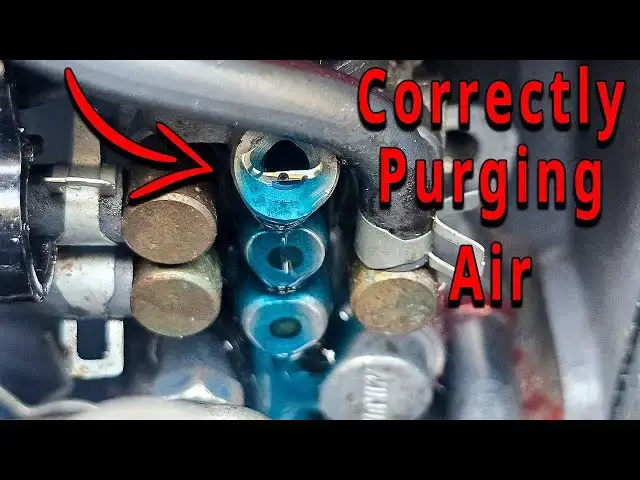
You just got to move these hoses out of your way. And for us, most oil pumps, they look like that, and you see that screw right there on the top
0:16
That is the bleed screw. We'll need to remove that bleed screw in order to bleed this
0:22
Now, it's important that this oil tank right here is full of oil, so that way it can gravity feed and be able to feed that
0:28
Now there's a couple tricks to catch the oil. One you can try and put a bag under there, but obviously on this model
0:34
You can't really get a bag down there. So we're gonna take a rag and stuff a rag down in there to catch any of the oil as it bleeds out
0:42
There's our rag in there, so now I'm gonna crack that screw and let it bleed So you can see that the oil's flowing out of there and you see how it's blown out of there and you see how it's
0:58
bubbling it's kind of hard to see it but every now and then you'll see it bubble there goes a bubble
1:02
there goes a bubble see how it's bubbling like that keeps making those bubbles all those air bubbles
1:09
you're just going to keep letting this bubble for i mean let this sit for at least a minute
1:15
sometimes a little bit more until you get a steady flow of oil coming out of that hole there
1:28
I was having trouble showing you what this looks like with the rag there
1:39
So I just took the rag out and I put a pan down here to catch all the oil and I just let
1:44
the oil drain out. So one of the thing that I forgot to say is this throttle linkage
1:49
You want this to be at wide open throttle. So you want the all the way open
1:53
When you do bleed it, you want to push this all the way down. Pretty easy
1:57
Like on this one, it's all connected to your... throttle linkages. So when you push this down and go to wide open throttle, that is what's
2:03
going to open that up. So if I move that back and forth, it's going to over here move that
2:08
back and forth. So make sure it's in the wide open position and then yeah, just put your
2:13
screw back in there once it's bled for, you only need to do it for about a minute and then
2:17
after one minute it should be pretty well purged. If you see any bubbles coming out, then
2:22
you know, let it keep going, but the bubbles should stop after about a minute. And then that
2:27
That means that it were purged all the way to here. Now we're going to need to run the engine on a premix in order to make sure that all these
2:37
oil lines coming off of the pump You can see there three oil lines one two three those coming off the pump they coming up here to the intakes and they coming right here on the top so like here one
2:51
and then there is another one right there and then there's another one on top of this one there so
2:56
all those oil lines go to our intake right here on the other side of the carburetor and that dumps
3:02
that oil in which then lubricates every side everything inside the crank case into the cylinders
3:08
So now, we're going to run the engine on a pre-mix of fuel
3:12
Mixing up the gas is pretty easy. You basically want a 50 to 1
3:16
For one gallon of gas, that would be 2.6 ounces. So I mean, I'm just going to put in there 3 ounces
3:23
Maybe a little bit more. It doesn't need to be exact, but I would be over 2.5, you know
3:28
A little bit thicker isn't going to be a bad thing. So I'm going to fill up just over, oh, just over 3 ounces
3:35
Looks like we're getting 4 ounces. So no big deal. Now I'm just gonna pour this into our fuel
3:43
And then we're going to shake this up real good. All right, we got our premix
3:50
So now what I'm gonna do is I just hooked up to the fuel line here
3:54
If you don't have something like this, like I do is follow the original one
3:58
It'll go inside. You should have a water separator. And then at that water separator
4:03
you can just take the fuel hose off of there in order to feel
4:07
to suck, you know, put fuel in there. That's just if you don't have something like this or
4:13
you know, another one, whatever. But either way, that's what that is. So now what I'm going to do
4:18
is stick this hose into here and I'm going to prime it up. I'm going to crack the carburetor bowls
4:23
So that drain there and then that drain there and then also this drain here. And I want to get
4:28
my premixed fuel into all these carburetors. That way I know I've got good oil and lubrication
4:34
getting to the engine since we haven't started this thing since we tore it all down to do
4:37
the gridline but I got the fuel the hose on the lower unit down there and so now what I'm
4:44
to do prime it up once I get fueled here then we'll start and run the engine on the hose and let it
4:49
run for about 10 minutes in order to get that oil pump to prime to where these right here
4:57
are dumping oil into the intakes I'm not sure if you'll be able to see this but it's got like a
5:06
you can tell it's premixed because you can see the blue tint to it or the greenish tint to it
5:11
so that's pretty much how you know if it's got the premix in there or not i mean these
5:16
carburetors were empty when i did this so pulling that out you see how it like got a blue color to it so we know 100 percent we got good premixed fuel to our carburetors So now I going to turn the water on and we will start and run the engine
5:31
Before I started up I am going to squirt some lubricant. This is just some cable-on-chain
5:37
lube. Just I'm going to squirt some basically some fogging oil in here into these cylinders
5:43
That way when we start it off it'll be nice and lubed up on all of our cylinder walls
5:51
Same thing for into the throttle bodies. I just scored some, basically fogging oil in there just to get some lube and oil all
6:02
in the cylinder crank case. I don't want to fire it dry because this thing has been sitting for a long time
6:06
So that way I got oil on everything. Now I can start it up and then our premixed fuel will be able to lubricate it from here on now
6:21
The The
7:21
Looks like she's running pretty good on the oil system as far as what we need to do next is it needs to really go in the water
7:33
I want to continue running on the premix and we need to get the RPMs up so that way this oil pump can really flush all these lines
7:42
I mean you can take these things off like you know you can pull this oil line off of here and be able to see if
7:51
If there's any oil, you know, yeah, you can see the oil in the line, but it's not really
7:56
going to like drip oil out of there. It's not, it doesn't put out that much oil
8:01
It not really an indication when you rev up the r pms you would see a lot more smoke coming out of the exhaust but you know you still you burning it on the pre so that not really a guarantee that the oil system is working but that is just something to note
8:14
now that's one way of purging out the air from the oil system another way is that top line that i
8:19
took off the oil line you can just take that off put it in a container and while running it on the
8:24
pre-mix if you disconnect that linkage down to the oil pump and hold it in the wide open position
8:29
it will also purge it out a lot quicker so you can idle the engine with that at wide open for like
8:34
like 10 minutes and that will purge all the air out and you'll be able to see it come out
8:38
into a container. I need to put that engine in the water. I'm going to be running it on premix
8:43
for the first 10, 15 gallons anyway, so I'm not really worried about that. I have other stuff
8:49
that I want to do. I just wanted to get that first initial prime done while it was out of the water
8:54
Now as far as in like an OX66, I think it's very similar to that system where you've got a very
9:00
similar oil pump and a bleed screw and then you can push it up. I want to say
9:04
say that it even feeds it to, yeah, it feeds the similar lines to it. So I want to say that's the
9:10
same. An HPDI is going to be completely different because you cannot run an HPDI in premix
9:16
and what you do for an HPDI is that you are going to want to, let's see here, let me remember
9:24
now on an HPDI, you're going to have to disconnect the throttle linkage on the oil pump itself
9:32
You're going to take it off. I want to say that it goes to the VST and you're going to hold it to the wide open position, start and run the engine, and it should come pouring out of there
9:41
Once all the air comes out, then you put it back onto the VST, and that's how you prime it on the HPDI
9:46
And then, like, an Opti max is also completely different. There's, like, two ways to do it
9:50
You can either, one, have a dealer or the computer for Mercury, and you're going to just use the computer to turn on the electric pump, and it will prime itself
10:00
and then once you get it all primed up, you're going to take the cap off of the oil tank
10:04
and once you take the cap off of the oil tank, you're just going to run the engine, and it will purge out all the air from the oil tank until it starts to come out the top
10:12
put the oil cap down, boom, you're done. The other way, if you don't have the computer, is you have to put it into a break-in mode
10:20
and you do that by turning the key on, and then I want to say that you shift the handle from neutral to forward position
10:28
like five times. It might be a couple more, but I want to say it's five times. And when you do that
10:34
it's going to turn on that electric oil pump. It's going to prime itself, and then it will put the
10:39
engine into a break-in period of two hours. So it's almost like it double oils for two hours
10:45
once you initiate that break-in period. Other than that, that is how you prime the oil system
10:51
on a two-stroke outboard
#Boats & Watercraft
#Vehicle Repair & Maintenance
#Boating